 CONCEPTMind Your Future
Interactive pronunciation book
Enter once with the email you registered, and every book in the series opens on this device.
A link and a six-digit code come to your email. One tap, and this device is signed in for a year: every book, the lessons, and the Coach.
CONCEPTMind Your FutureThese are the symbols you will see in a dictionary. Click any one to hear it. You do not need to memorize them.
American English says the r everywhere, including after a vowel: car, hard, four, bird, mother, first. This is called being rhotic, and it is one of the two or three biggest single moves toward an American sound.
Two separate things can be wrong, and you need to know which apply to you, because they need different work.
The sound of your r: whether it is a trill, a tap, a throat sound, or the American glide. And where you say it: whether it appears after a vowel at all.
Question one: what does your r sound like at the start of a word? Say red. If it rolls or taps, you have an alveolar trill, as in Italian, Spanish, Polish and Russian. If it comes from the back of your throat, you have a uvular r, as in French and German. If it sounds like an h, so red comes out as hed, that is the Brazilian pattern.
Question two: do you say the r in car and hard? Say them slowly and listen. If the r disappears, your language is non-rhotic in that position, or you have learned a non-rhotic English model.
What this means for you. If you speak Italian or Spanish, your distribution is usually fine and only the quality needs changing, which is good news: one habit to replace, no rule to relearn. If you speak Brazilian Portuguese, both need work. If you learned British English, your sounds may be fine but your distribution is not.
Two separate things can be wrong: what your r sounds like, and whether you say it after a vowel at all. Diagnose which apply to you before you practice.
The American r has no trill, no tap and no throat friction. It is a glide, and the tongue touches nothing.
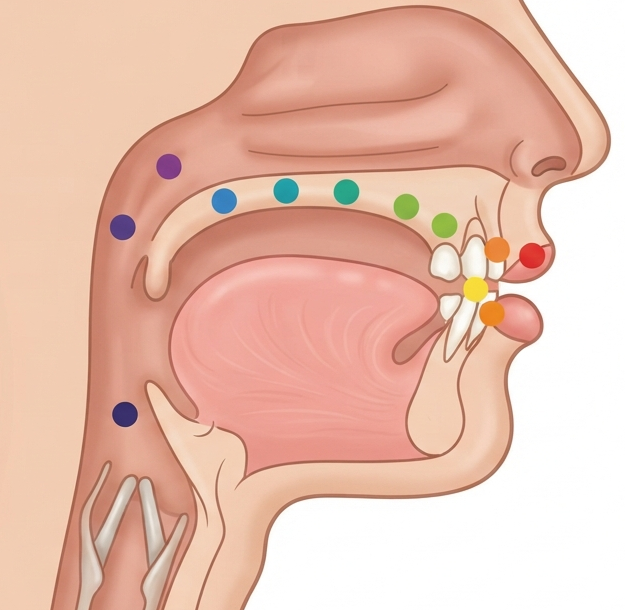
There are two ways to make it and both are correct. Curled: your tongue tip curls up and back toward the roof of your mouth without touching, and the sides press against your upper back teeth. Bunched: your tongue tip stays down and the whole body of your tongue bunches up and back. Many Americans do it this way. In both, your lips round slightly and nothing makes contact.
The way in. Produce a long errr on its own, with no word around it. Hold it for two seconds. Nothing should vibrate and nothing should touch. Then attach it to a word: errr, red. errr, run.
For the final r, hold the r-color all the way to the end of the word. Car does not end on the vowel. It ends on the r.
Make a long errr on its own, held for two seconds. Nothing should vibrate and nothing should touch. Then attach it to a word.
I play one word. Tap the one you heard. No speaking yet, just listening.
Play each pair deliberately and feel the one difference. This is where the sound stops being abstract.
Pick anything above, then record yourself saying it. Your recording appears in red over the model in gray. You are comparing shapes, not chasing a score.
Two different things can be wrong with your r. What are they, and which do you need to fix?