 CONCEPTMind Your Future
Interactive pronunciation book
Enter once with the email you registered, and every book in the series opens on this device.
A link and a six-digit code come to your email. One tap, and this device is signed in for a year: every book, the lessons, and the Coach.
CONCEPTMind Your FutureThese are the symbols you will see in a dictionary. Click any one to hear it. You do not need to memorize them.
These five sounds sit close together in your mouth, and several of them are missing or differently distributed in most languages. When they blur, real words merge: yes and jess, year and jeer, share and chair, ship and chip, wash and watch.
They are also very common in professional English: question, future, decision, usual, general, change, pressure, measure.
The y sound at the start of a word is the most common problem. Many languages turn it into a j: yes becomes jess, year becomes jeer. If your language has j but no y, or writes them with the same letter, expect this.
Sh and ch blur for speakers whose language has one but not the other, or has neither. Share and chair merge, wash and watch merge.
The zh sound, as in measure and usual, is missing from many languages including Italian and Spanish. If you have it, as French and Portuguese speakers do, you are ahead here. If not, it usually becomes a j sound.
The y at the start of a word is the most common trap: yes becomes jess, year becomes jeer.
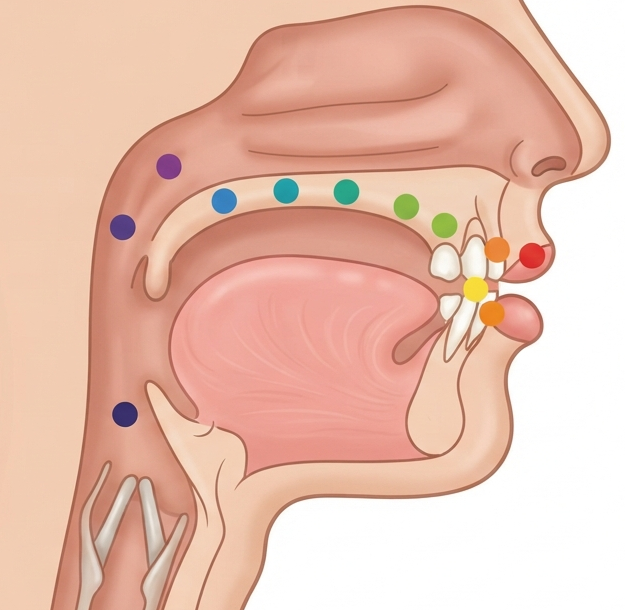
The y in yes. Your tongue rises toward the roof of your mouth but does not touch it, and the air keeps flowing. If your tongue makes contact, you have produced a j.
The j in just. A full stop first, then a release into friction. Two parts: a d, then a zh.
The sh in share. Continuous friction, no stop, lips slightly rounded.
The ch in chair. A stop, then that same sh. Two parts: a t, then a sh.
The zh in measure. Continuous friction like sh, but with your voice on.
The pattern that ties them together: sh and zh flow continuously, ch and j start with a stop. And the difference within each pair is just voicing, so once you can do sh you can do zh by turning your voice on.
Remember the pattern: sh and zh flow continuously; ch and j start with a stop. Within each pair, the only difference is your voice on or off.
I play one word. Tap the one you heard. No speaking yet, just listening.
Play each pair deliberately and feel the one difference. This is where the sound stops being abstract.
Pick anything above, then record yourself saying it. Your recording appears in red over the model in gray. You are comparing shapes, not chasing a score.
You can already say sh. How do you get to the sound in measure from there?