 CONCEPTMind Your Future
Interactive pronunciation book
Enter once with the email you registered, and every book in the series opens on this device.
A link and a six-digit code come to your email. One tap, and this device is signed in for a year: every book, the lessons, and the Coach.
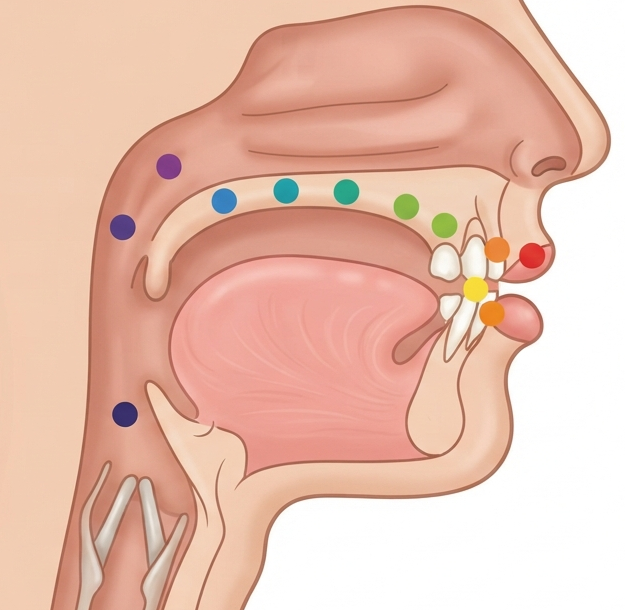
CONCEPTMind Your FutureThese are the symbols you will see in a dictionary. Click any one to hear it. You do not need to memorize them.
The same problem as the last unit, at the back of your mouth instead of the front. Full and fool, pull and pool, look and Luke.
Fewer word pairs depend on this one, so it is less urgent than ship and sheep. But it affects a group of very frequent small words, could, would, should, good, book, put, and getting those wrong is heard constantly.
Again, if your language has one u sound, English has two and you will hear one.
Most learners default to the fool vowel, so full becomes fool, good becomes goood, put rhymes with boot. The words come out sounding stretched and slightly formal.
The same trap applies. This is not about length. A long and a short version of the same vowel is still one vowel to an American ear.
Most learners default to the fool vowel, so full becomes fool and put rhymes with boot. A long and a short of the same vowel is still one vowel to an American ear.
Fool. Tongue high and back, muscles tight, lips firmly rounded and pushed forward.
Full. Everything relaxes. The tongue drops slightly and comes forward a little, and the lip rounding loosens.
The picture: fool is a tight whistle shape. Full is the same shape gone soft.
The way in. Say fool and hold it. Let the tension go without stopping the sound. It becomes full. Back and forth: fooo, uh, fooo, uh.
Mirror check. On fool your lips push forward noticeably. On full they barely move.
Mirror check: on fool your lips push forward noticeably. On full they barely move.
I play one word. Tap the one you heard. No speaking yet, just listening.
Play each pair deliberately and feel the one difference. This is where the sound stops being abstract.
Pick anything above, then record yourself saying it. Your recording appears in red over the model in gray. You are comparing shapes, not chasing a score.
What do units 14 and 15 have in common, and why does that help?