 CONCEPTMind Your Future
Interactive pronunciation book
Enter once with the email you registered, and every book in the series opens on this device.
A link and a six-digit code come to your email. One tap, and this device is signed in for a year: every book, the lessons, and the Coach.
CONCEPTMind Your FutureThese are the symbols you will see in a dictionary. Click any one to hear it. You do not need to memorize them.
English has one letter l but two versions of the sound, and the difference is one of the clearest markers of a non-native accent.
Before a vowel, in light and yellow, the l is light and forward. At the end of a syllable, in milk and full, it is dark: the back of your tongue lifts and the sound gets heavier.
Most learners get the first one right and the second one wrong, in one of two opposite ways.
You turn the dark l into a w. Milk becomes miwk, full becomes fuu, hotel becomes hotew. Your tongue tip never arrives and your lips round instead. This is very strong in Brazilian Portuguese and appears in Polish and some other languages.
Or you keep the l light everywhere. Milk and full come out with the same clear forward l you use in light. Nothing is wrong exactly, but it sounds thin and noticeably not American. This is common in Italian, Spanish, French and German.
How to tell which you do. Say full and hold the last sound for two seconds. Look in a mirror. If your lips round into a kiss shape, you are making a w. If your tongue tip is pressed against the ridge behind your top teeth and your lips are flat, you have an l, and the question is only whether it is dark enough.
Say full and hold the last sound for two seconds. If your lips round into a kiss shape, you are making a w, not an l.
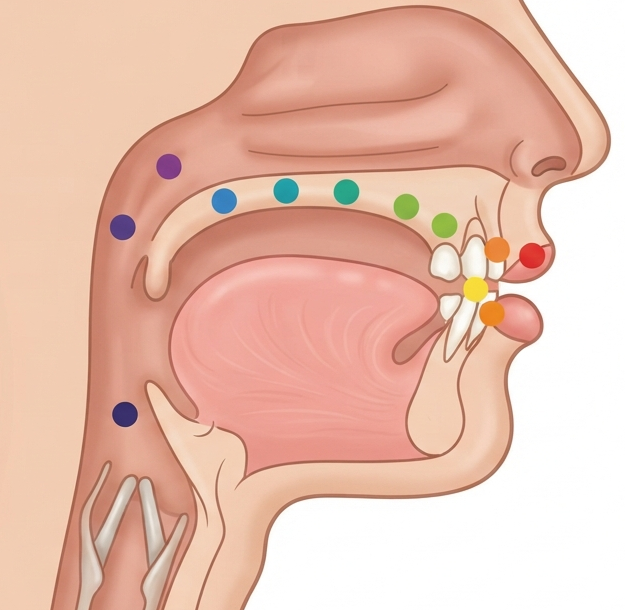
If you produce a w, the fix is physical and has two parts. Your tongue tip must touch the ridge behind your top teeth, and your lips must stay flat. Put a finger at each corner of your mouth to block the rounding, then say milk and force the tongue contact. The picture: your tongue tip posts a letter against the ridge on every final l.
If your l is too light, the fix is at the back of your tongue, not the tip. Keep the tip where it is and lift the back of your tongue toward the soft palate, as if you were about to say a very deep oo at the same time. The sound should feel heavier and lower.
Compare light and full. In light, only the tip is doing work. In full, the tip and the back are both engaged.
For the dark l the tip touches behind your top teeth and the lips stay flat. Compare light, only the tip works, and full, the tip and the back both engage.
I play one word. Tap the one you heard. No speaking yet, just listening.
Play each pair deliberately and feel the one difference. This is where the sound stops being abstract.
Pick anything above, then record yourself saying it. Your recording appears in red over the model in gray. You are comparing shapes, not chasing a score.
Why is just pronounce the l not enough advice for most students?