 CONCEPTMind Your Future
Interactive pronunciation book
Enter once with the email you registered, and every book in the series opens on this device.
A link and a six-digit code come to your email. One tap, and this device is signed in for a year: every book, the lessons, and the Coach.
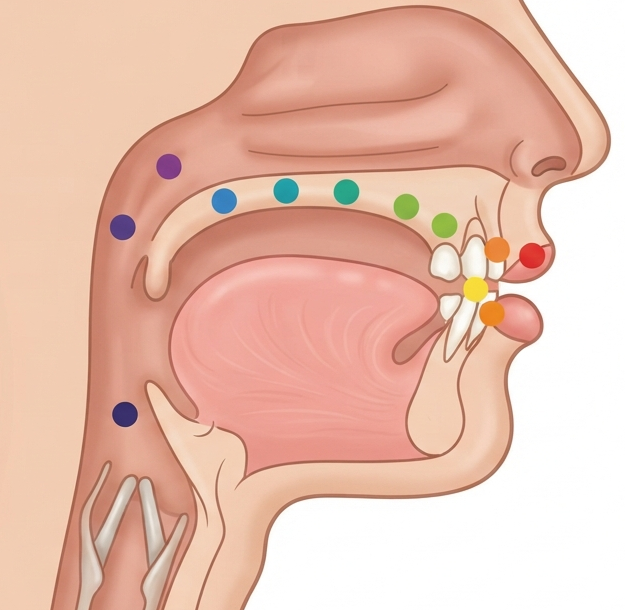
CONCEPTMind Your FutureThese are the symbols you will see in a dictionary. Click any one to hear it. You do not need to memorize them.
English ng is one single sound, and in most words there is no g after it. Sing, long, thing, running, morning all end on a hum, not on a hard g.
Adding a g inserts a consonant that is not there. It is a small thing, and it is heard on every -ing word you say, which is a lot of them.
If your language does not allow a nasal at the end of a syllable without releasing it, you will add a g. Singing becomes sing-ging, long becomes long-g. This is common in Italian and in several other languages.
The confusing part is that English sometimes does have a real g there: finger, longer, stronger, hunger, England. So you cannot simply decide never to say g. You have to learn where it belongs.
English sometimes does have a real g there: finger, longer, stronger, England. So you cannot simply decide never to say it.
Stop the sound at the back of your tongue and let it fade. Do not release anything. The picture: ng is a hum that dissolves. Adding a g is like tapping a bell after it has already rung.
The best training tool is the pair singer and finger. Singer has no g. Finger has a real one. Say them back to back until you can feel the difference in your tongue rather than just hear it.
Say singer and finger back to back. Singer has no g. Finger has a real one. Feel the difference in your throat.
I play one word. Tap the one you heard. No speaking yet, just listening.
Play each pair deliberately and feel the one difference. This is where the sound stops being abstract.
Pick anything above, then record yourself saying it. Your recording appears in red over the model in gray. You are comparing shapes, not chasing a score.
Singer and finger look like they rhyme. What is different?