 CONCEPTMind Your Future
Interactive pronunciation book
Enter once with the email you registered, and every book in the series opens on this device.
A link and a six-digit code come to your email. One tap, and this device is signed in for a year: every book, the lessons, and the Coach.
CONCEPTMind Your FutureThese are the symbols you will see in a dictionary. Click any one to hear it. You do not need to memorize them.
Consonants are the easy part. Vowels are where most accents actually live.
English has about fifteen vowel sounds. If your language has five or seven, you are being asked to hear and produce distinctions that do not exist in your system, and the pairs that collapse are common words.
This unit is a map, like unit 1. You are not fixing anything yet. You are finding out which parts of the vowel space are already yours and which are missing.
Ship and sheep. Full and fool. Cat, cut and cart. Man and men. Play each pair below and decide whether you hear one word or two. Be honest. If they sound identical, that is not a failure, it is your map, and it tells you exactly where to spend your time.
There is one more thing, and it is genuinely difficult. English has a vowel that appears only in weak syllables and is the most common vowel in the language. If your language gives every syllable a full clear vowel, that one has to be built from nothing. It is unit 17.
English spelling is unreliable here and often actively misleading. Say these aloud and then listen to the recording: woman, women, heard, great, break, blood, though.
Notice how far off you were. This is not about your ability. It is about the writing system. Many people have built their vowel targets from the spelling, and that misinformation has to be surfaced before it can be replaced.
Say woman, women, heard, great, break, then listen to the recording. Notice how far the spelling led you off. This is the writing system, not your ability.
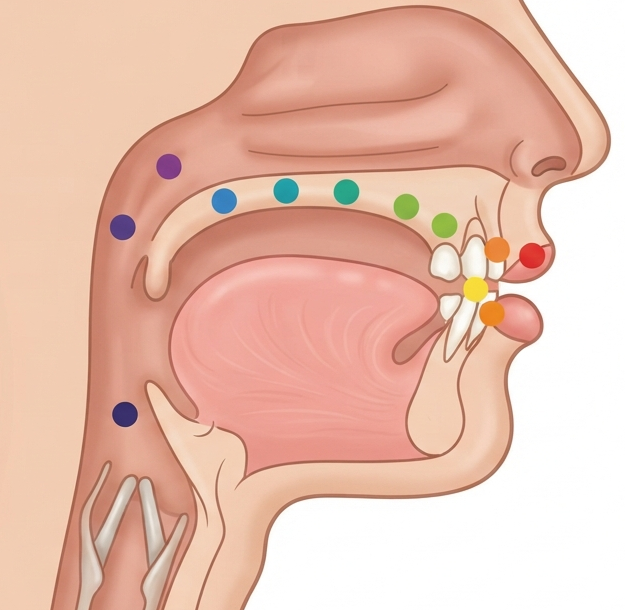
I play one word. Tap the one you heard. No speaking yet, just listening.
Play each pair deliberately and feel the one difference. This is where the sound stops being abstract.
Pick anything above, then record yourself saying it. Your recording appears in red over the model in gray. You are comparing shapes, not chasing a score.
You listened to ship and sheep and heard the same word both times. What does that tell you, and what should you do first?