 CONCEPTMind Your Future
Interactive pronunciation book
Enter once with the email you registered, and every book in the series opens on this device.
A link and a six-digit code come to your email. One tap, and this device is signed in for a year: every book, the lessons, and the Coach.
CONCEPTMind Your FutureThese are the symbols you will see in a dictionary. Click any one to hear it. You do not need to memorize them.
West and vest. Wine and vine. Worse and verse. If these merge, ordinary sentences become confusing, and the error is very audible.
This does not affect everyone. If you already keep w and v apart, read the unit quickly and move on.
Several languages have v but no w, or have a sound that sits between them. German and Dutch speakers often produce v where English wants w. Some Italian, Indian and Slavic speakers produce a compromise sound made with both lips, which is neither one.
The confusion usually runs in both directions once it starts. You may say vest for west and then, correcting, say west for vest.
W has no teeth involved. Your lips round, and the sound glides out of that rounding. It starts like a very short oo.
V uses your teeth. Your top teeth touch your bottom lip, and you push voiced air through the gap so it buzzes.
The picture: w is a small blown kiss. V is a buzzing lip-bite.
The physical check is easy. Put a finger lightly against your top teeth. On v you feel your lip make contact. On w you feel nothing.
Put a finger lightly against your top teeth. On v you feel your lip make contact. On w you feel nothing.
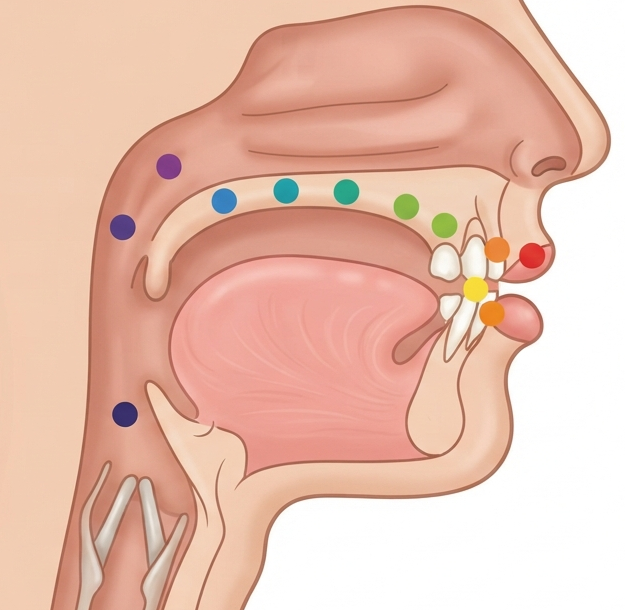
I play one word. Tap the one you heard. No speaking yet, just listening.
Play each pair deliberately and feel the one difference. This is where the sound stops being abstract.
Pick anything above, then record yourself saying it. Your recording appears in red over the model in gray. You are comparing shapes, not chasing a score.
Why practice vest to west as well as west to vest?