 CONCEPTMind Your Future
Interactive pronunciation book
Enter once with the email you registered, and every book in the series opens on this device.
A link and a six-digit code come to your email. One tap, and this device is signed in for a year: every book, the lessons, and the Coach.
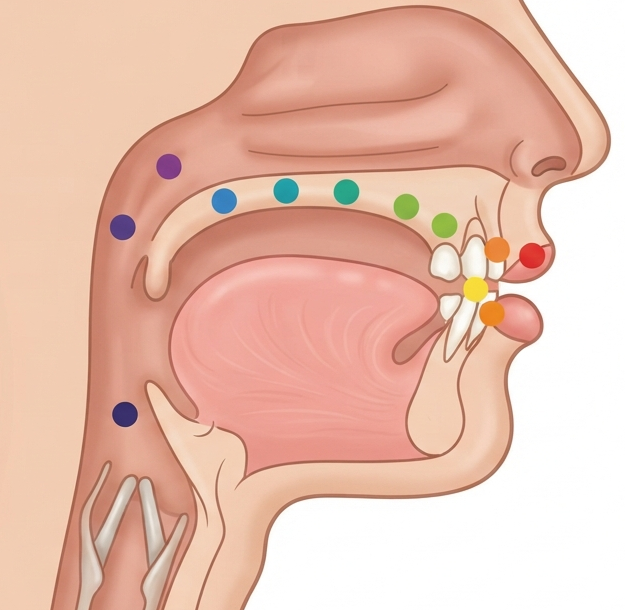
CONCEPTMind Your FutureThese are the symbols you will see in a dictionary. Click any one to hear it. You do not need to memorize them.
Bad and bat. Prize and price. Leave and leaf. Save and safe. These pairs differ only in the last consonant, and if they merge for you, real words become ambiguous.
There is a surprise in how English marks the difference, and once you know it, this unit gets much easier.
Two things usually happen together.
You harden the final consonant. A final d comes out as t, a final z as s, a final v as f. This is extremely common: German, Russian, Polish, Turkish, Dutch and many others do it as a rule, and speakers of many other languages do it in English anyway.
And you keep the vowel the same length in both words. This is the part that actually costs you.
You harden the ending and keep the vowel the same length. Keeping the vowel the same is the part that actually costs you.
Here is the surprise. English listeners mainly use the length of the vowel before the consonant, not the consonant itself, to decide which word they heard.
Bad has a noticeably longer a than bat. Prize has a longer i than price. The consonant matters, but the vowel matters more.
So lead with length. Stretch the vowel before a soft ending and clip it before a hard one. The picture: a soft ending gets a long run-up and a gentle landing. A hard ending is short and sharp.
Then add the second cue. Put a hand on your throat. On bad, prize, leave you should feel a buzz continuing into the final consonant. On bat, price, leaf the buzz stops.
Put a hand on your throat. On bad, prize, leave the buzz continues into the final consonant. On bat, price, leaf it stops.
I play one word. Tap the one you heard. No speaking yet, just listening.
Play each pair deliberately and feel the one difference. This is where the sound stops being abstract.
Pick anything above, then record yourself saying it. Your recording appears in red over the model in gray. You are comparing shapes, not chasing a score.
Which tells an American that you said bad and not bat?