 CONCEPTMind Your Future
Interactive pronunciation book
Enter once with the email you registered, and every book in the series opens on this device.
A link and a six-digit code come to your email. One tap, and this device is signed in for a year: every book, the lessons, and the Coach.
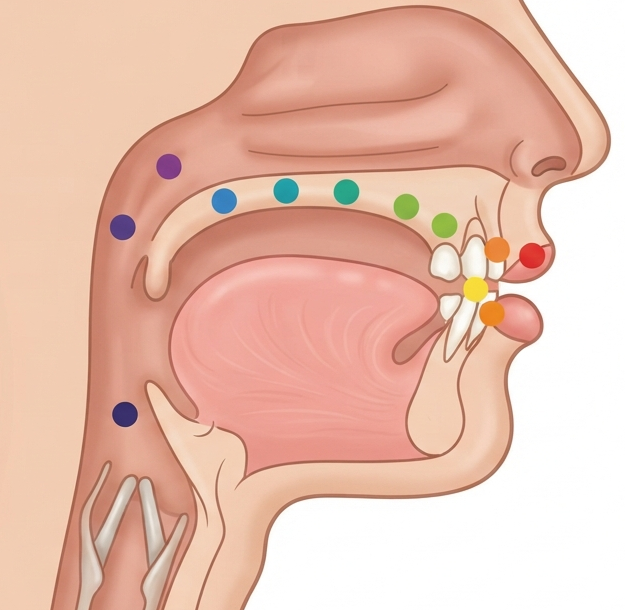
CONCEPTMind Your FutureThese are the symbols you will see in a dictionary. Click any one to hear it. You do not need to memorize them.
Worked, learned, wanted. One spelling, three pronunciations, and the choice is not random.
Two things can go wrong. You can pick the wrong one, which marks the accent. Or you can add a syllable that is not there, which changes the rhythm of the sentence and is much more disruptive.
Worked is one beat, not two. If you say work-ed, you have added a beat, and everything in Part Four depends on getting beats right.
If your language pronounces every written vowel, you will see -ed and say a vowel. This is the main error, and it comes from the page rather than the ear.
If your language does not allow the resulting consonant groups, worked ending in kt, you may simplify instead and drop the ending entirely, which loses the past tense.
Both errors come from unit 3. One adds a vowel to fix an illegal ending, the other deletes a consonant. Same mechanism.
If your language says every written vowel, you will see -ed and add a syllable. That error comes from the page, not the ear.
The rule depends only on the sound before the ending, never on the spelling.
If the verb ends in a t or d sound, add a syllable. Wanted, needed, started. This is the only case where -ed is its own beat.
If the verb ends in any other voiceless sound, p, k, f, s, sh or ch, the ending is a t. Worked, watched, hoped, laughed.
If the verb ends in any other voiced sound, a vowel or b, g, v, z, m, n, l, r, the ending is a d. Learned, played, called, loved.
The shortcut: put your hand on your throat. If the last sound before -ed buzzes, you get a d. If it does not, you get a t. If it is already a t or a d, you get a whole extra syllable.
Then clap the beats. Worked is one clap. Wanted is two.
Put a hand on your throat: if the sound before -ed buzzes, you get a d; if not, a t; if it is already a t or d, add a syllable. Then clap the beats: worked is one clap, wanted is two.
Pick anything above, then record yourself saying it. Your recording appears in red over the model in gray. You are comparing shapes, not chasing a score.
Worked and wanted both end in -ed. Why is one word one beat and the other two?