 CONCEPTMind Your Future
Interactive pronunciation book
Enter once with the email you registered, and every book in the series opens on this device.
A link and a six-digit code come to your email. One tap, and this device is signed in for a year: every book, the lessons, and the Coach.
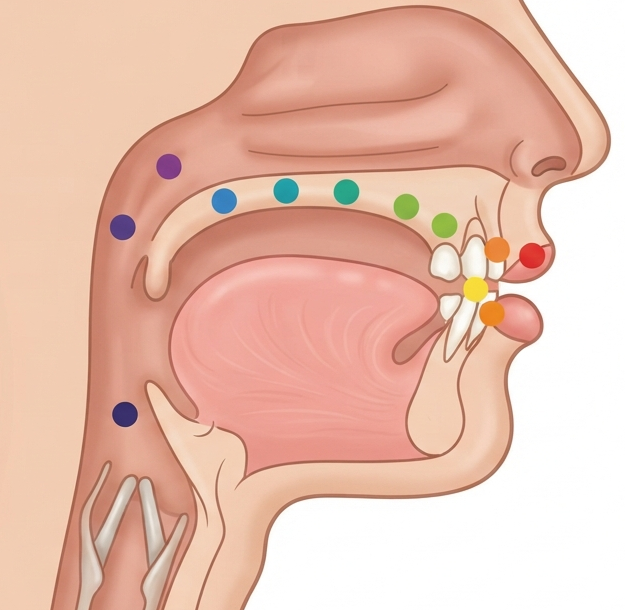
CONCEPTMind Your FutureThese are the symbols you will see in a dictionary. Click any one to hear it. You do not need to memorize them.
This is a small unit with a large practical cost.
Thirteen and thirty are different numbers. So are fifteen and fifty, forty and fourteen. If your listener cannot tell them apart, you have misquoted a price, a quantity, a deadline or a room number, and neither of you will notice until something goes wrong.
In purely commercial terms this is the most expensive error in the book.
The endings differ, -teen against -ty, but in fast speech the difference is small and unreliable. English speakers do not depend on it.
The stress is what carries it. ThirTEEN has the beat on the second syllable. THIRty has it on the first.
If your language does not use stress to distinguish words, you will produce the two with the same rhythm, and then only the ending is left to carry the load. In a noisy room or on a phone line, it will not.
A second problem: the American t. In thirty the t is a flap, so it sounds almost like a d. THIRdy. If you produce a crisp t there, you sound careful rather than American, and you also lose one more cue that would have helped.
The endings will not save you. Stress carries it: thirTEEN leans forward, THIRty leans back. And thirty has a flap t: THIRdy.
The teens: strong on the second syllable, and the ending is clear. ThirTEEN, fourTEEN, fifTEEN.
The tens: strong on the first syllable, and the ending is weak and flapped. THIRdy, FORdy, FIFdy.
The way in. Say them in pairs, exaggerating the beat, and tap the table on the strong syllable so you can feel the difference physically.
Then test it for real. Say a price or a quantity from your own work, record it, and play it to a colleague without telling them the number. If they get it wrong, the beat is the thing to fix, not the ending.
Say a price or a quantity from your own work, record it, and play it to a colleague without telling them the number. If they get it, you have it.
I play one word. Tap the one you heard. No speaking yet, just listening.
Play each pair deliberately and feel the one difference. This is where the sound stops being abstract.
Pick anything above, then record yourself saying it. Your recording appears in red over the model in gray. You are comparing shapes, not chasing a score.
On a bad phone line, which tells your listener you said fifty and not fifteen?