 CONCEPTMind Your Future
Interactive pronunciation book
Enter once with the email you registered, and every book in the series opens on this device.
A link and a six-digit code come to your email. One tap, and this device is signed in for a year: every book, the lessons, and the Coach.
CONCEPTMind Your FutureThese are the symbols you will see in a dictionary. Click any one to hear it. You do not need to memorize them.
American English fuses r into the vowel before it, producing a set of five sounds that behave as a system: car, core, care, clear, cure.
These are not five separate facts to memorize. They are five points that have to stay apart from each other, and if they drift together, common professional words become ambiguous: far and four, hair and here, share and sure, heart and hurt.
This is one of the largest additions to this edition. It was previously taught as a single item, and treating a five-way system as one item is why students who studied it still could not produce it reliably.
If your language drops the r after a vowel, all five of these lose their identity at once, because the r is what defines them.
If your language has an r but a different kind, trilled, tapped or in the throat, you may produce all five with the correct distribution but the wrong quality, so they sound foreign rather than ambiguous.
If you learned British English, you will have learned most of these without the r, which is a correct British target and the wrong American one.
Taught as one item, a five-way system is exactly why students plateau here. Treat it as five distances, not one sound.
Each one is a vowel that slides into the r and holds there. The r is not added afterward. It is inside the sound.
Car is the open ah of unit 16, then r. Core is a rounded aw, then r, with the lips rounded throughout. Care is the e of bet, then r. Clear is the ih of ship, then r. Cure is the oo of full, then r.
The picture: five different doors, all opening onto the same corridor. The vowel is the door. The r is the corridor.
The way in. Say the four core ones as a sequence, slowly: car, core, care, clear. Then backward. As in unit 16, you are training the distances between them, not five isolated sounds.
A note on cure. Many Americans have merged this one into core, so sure and shore sound alike. You do not need to fight for this distinction. Matching the merger is correct.
Say the four core ones slowly: car, core, care, clear. Then backward. Five doors, all opening onto the same corridor. The vowel is the door, the r is the corridor.
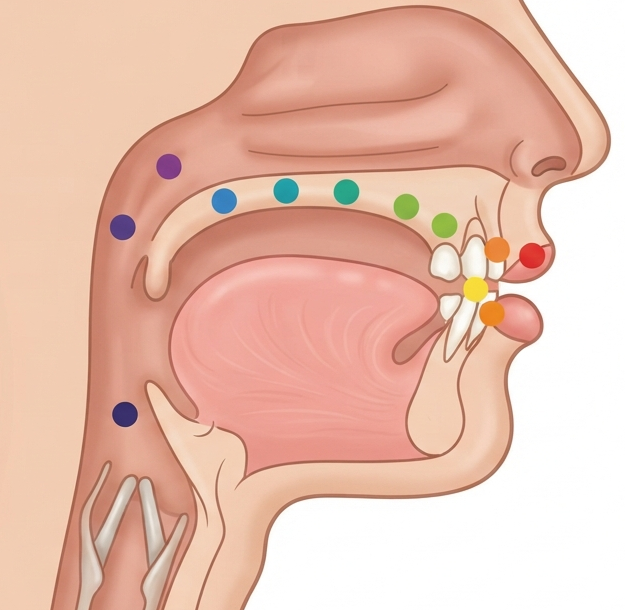
I play one word. Tap the one you heard. No speaking yet, just listening.
Play each pair deliberately and feel the one difference. This is where the sound stops being abstract.
Pick anything above, then record yourself saying it. Your recording appears in red over the model in gray. You are comparing shapes, not chasing a score.
Why does this unit tell you not to worry about keeping sure and shore apart?