 CONCEPTMind Your Future
Interactive pronunciation book
Enter once with the email you registered, and every book in the series opens on this device.
A link and a six-digit code come to your email. One tap, and this device is signed in for a year: every book, the lessons, and the Coach.
CONCEPTMind Your FutureThese are the symbols you will see in a dictionary. Click any one to hear it. You do not need to memorize them.
The h carries meaning in English. Eat and heat are different words. So are air and hair, old and hold, ear and hear, arm and harm.
There are two opposite errors here, and many people make both: dropping the h where it belongs, and adding one where it does not.
If your language writes h but does not say it, which is true of Italian, French, Spanish and Portuguese, you will drop the English h. House becomes ouse, have becomes ave.
Then something interesting happens. Once you notice the problem and start correcting it, you often over-correct and put an h where none belongs. Away becomes ahway, egg becomes hegg.
If that is you, take it as good news. The spurious h means you have started listening for the sound. You are one step from putting it in the right places, not one step backward.
One special case. If you speak Brazilian Portuguese, your h is usually fine, but your r at the start of a word can come out as an h, so red sounds like hed. That is unit 12, not this one.
Once you start fixing the missing h, you often over-correct and add one where none belongs. Take the spurious h as good news: it means you have started listening for the sound.
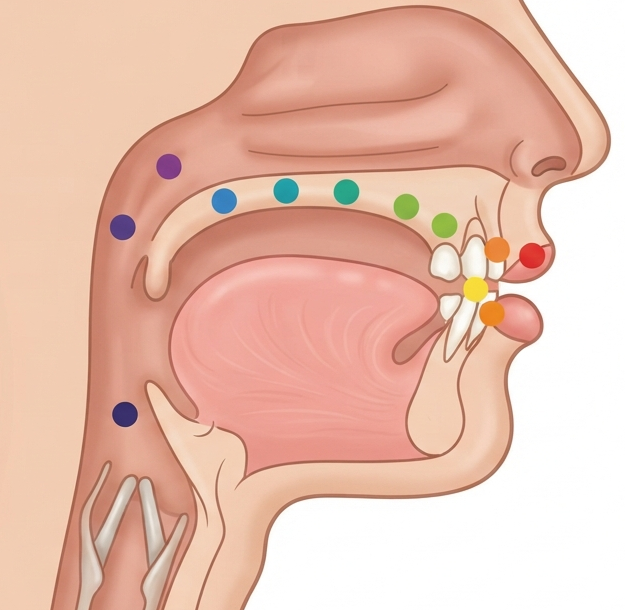
The h is just an audible out-breath at the start of a vowel. Nothing more. The picture: warming your hands on a cold day. Haaa.
Fog a mirror with your breath, then attach a vowel to it. Haa, house. That is the whole sound.
Then hunt the other error. Say away, apple, open, easy. There must be no breath in front of them.
Fog a mirror with your breath, then attach a vowel: haa, house. Then say away, apple, open, with no breath in front of them.
I play one word. Tap the one you heard. No speaking yet, just listening.
Play each pair deliberately and feel the one difference. This is where the sound stops being abstract.
Pick anything above, then record yourself saying it. Your recording appears in red over the model in gray. You are comparing shapes, not chasing a score.
Which shows more progress: dropping the h in house, or adding one in away?