 CONCEPTMind Your Future
Interactive pronunciation book
Enter once with the email you registered, and every book in the series opens on this device.
A link and a six-digit code come to your email. One tap, and this device is signed in for a year: every book, the lessons, and the Coach.
CONCEPTMind Your FutureThese are the symbols you will see in a dictionary. Click any one to hear it. You do not need to memorize them.
These two sounds live inside the most common words in English: the, this, that, they, think, three, month. You cannot get through a sentence without them, which means whatever you do with th, you do it constantly.
Sometimes it changes your meaning. Think and sink are different words. So are thing and sing, path and pass, three and tree.
More often it costs you something subtler. An American hears the substitution immediately, on every sentence, and it is one of the clearest markers that English is not your first language.
An honest note. Measured strictly, very few English words depend on th alone, and some researchers argue you can skip it. This book teaches it anyway, not because th breaks meaning often, but because Americans notice it every single time.
Almost certainly your language does not have these sounds. Very few do. So your mouth reaches for the nearest thing it already owns, and there are two common substitutes.
When you are speaking freely, th usually becomes t or d. Think comes out as tink, the as duh, mother as muhder.
When you slow down and concentrate, the same sounds often become s and z instead. Think comes out as sink, these as zeez.
Most people do both and never notice. The second habit is the expensive one. Tink costs you polish. Sink costs you the word.
Expect the voiced one to be harder. This, that, mother are more difficult than think, three, path, and they are usually the last thing to click. Two new things are happening at once: a new way of moving air, and a voicing choice you are not yet paying attention to.
Most people do both substitutes and never notice. The s and z habit is the expensive one, because it changes the word. And expect the buzzing th in this, that, mother to be the last to click.
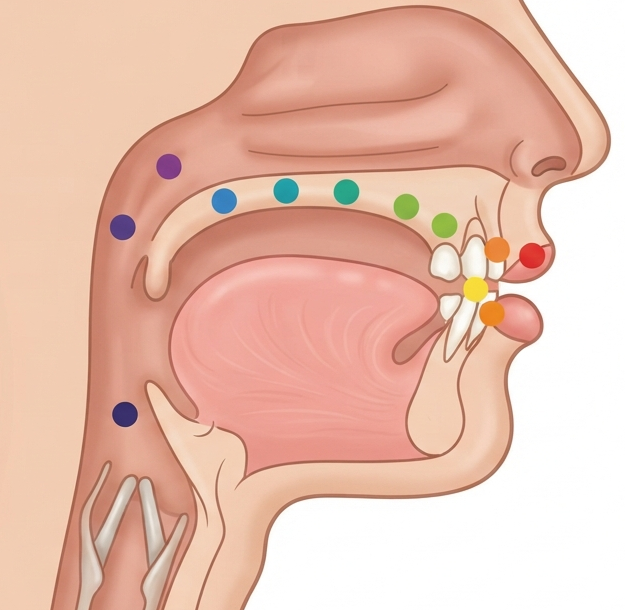
The quiet one, in think. Rest your tongue tip lightly against your top front teeth, or just under them. Blow air past it. No voice.
The buzzing one, in this. Same position. Now switch your voice on so your throat buzzes.
The picture to hold: a tiny, polite air leak between your tongue and your teeth, like letting the air out of a bicycle tire very slowly.
Do this at a mirror. You should be able to see your tongue tip appear between your teeth. If you cannot see it, it is not there. For the buzzing one, put a hand on your throat and feel for the buzz.
Do this at a mirror. You should see your tongue tip between your teeth. If you cannot see it, it is not there yet. For the buzzing one, put a hand on your throat and feel the buzz.
I play one word. Tap the one you heard. No speaking yet, just listening.
Play each pair deliberately and feel the one difference. This is where the sound stops being abstract.
Pick anything above, then record yourself saying it. Your recording appears in red over the model in gray. You are comparing shapes, not chasing a score.
You say I sink so when reading aloud, but I tink so when you are talking. Is that two problems or one?